Interview with Friedelind Wagner by Paul Hess
»The son of Richard Wagner is as an artist the victim of a pedantic theory whereby he is not judged for what he is worth, but according to a supposed law of nature by which a great man cannot have a great son, though Johann Sebastian Bach had two very great sons and Siegfried Wagner is a more profound and more original artist than many who are famous today.«1
These are not the words of some adoring relative or sycophant, but are the stated opinion of no less than Arnold Schoenberg. Their validity is as great today as on the day they were first written.
Guarded by no fierce dragon, the treasure of Siegfried Wagner’s well-crafted, expressive, and communicative music awaits rediscovery and revival. Given an impartial hearing, it could only bring genuine pleasure to musicians and public alike.
 According to Lowell Liebermann, »Although Siegfried Wagner absorbed aspects of leitmotivic construction from his father’s works, his own works do not comfortably fit into the category of Wagner imitations as is often assumed. In fact, the music of Siegfried Wagner is remarkably un-Wagnerian to an extent that most of his contemporaries could not claim. Certainly the influence is there; however, it is tempered by a thorough knowledge and love of Italian operatic literature – particularly Verdi – and by the heritage of Siegfried’s teacher Humperdinck and the Märchenoper tradition. Siegfried was perhaps not an ›innovator‹ in any sense; rather, it was through the amalgamation and distillation of the musical resources available to him that he was able to create a unique musical language – a language as meaningful and telling of the period in which he lived as that of the creations of his more ›innovative‹ or ›avantgarde‹ contemporaries.«2
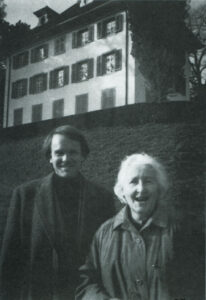
Friedelind Wagner, Siegfried’s daughter, shared with me some memories, thoughts, and feelings as we talked about her father.
Paul Hess: Your father was an extraordinarily versatile and multi-faceted individual all his life, with music only one among many arts he practiced. He surely did not lack for experience and vital influences in his youth. What were some of these?
Friedelind Wagner: In his memoirs, Siegfried Wagner describes his father raising his fists against Bayreuth’s clouds, exclaiming, ›Those damned potato sacks!‹3 To escape Bayreuth’s rough climate, Richard packed the family off to Italy for winters, where the seven-year-old Siegfried’s passion for architecture was awakened. Churches, palaces, and theaters filled his sketchbooks. He invented a whole town, ›Stadt Wankel‹, in an Italian style of architecture. Though exposed to music day and night, Siegfried’s main interests during his father’s lifetime were writing epic poems, dramas, and ballads, and drawing incessantly. Later, his father’s disciple Humperdinck taught him harmony and counterpoint for one year, after which he declared that Siegfried had nothing more to learn from him. Having learned English, French, and Italian, Siegfried also mastered Latin and ancient Greek, which enabled him to converse with priests in either of these tongues when at a loss for a local language on his travels.
In 1892, at the age of twenty-two, he received an invitation to make a five-month ocean voyage to the Far East, visiting China, Japan, India, and the Philippines. There exists a series of his watercolors done on this journey. He was accompanied by an English friend, Clement Harris. Harris, who was himself a talented composer, died in 1898 fighting in the Greek war of independence, having been talked into participating by an Englishwoman, over tea!
The turning point in Siegfried’s life occurred on this trip, in Singapore, shortly before Easter, when from a public building there unexpectedly came the strains of a Bach chorus. Overcome and speechless at the staggering impression Bach’s genius made in this faraway, tropical surrounding, Siegfried resolved thereafter to dedicate his life to music.
As an adult, he continued to vacation in Italy, never missing a chance to attend small, provincial opera theaters. Though not on a high artistic level, performances were delivered with a lot of gusto and temperament and were received in such an atmosphere of informality – mothers nursing their babies in the audience, for instance – that Siegfried always enjoyed himself immensely.
Paul Hess: A pronouncedly melodic, singing character permeates your father’s music. For a German musician, especially, his relationship with Italian and French opera is noteworthy. How did this begin?
Friedelind Wagner: How far back it began cannot be known, but I can tell you this story: one day his grandfather, Franz Liszt, and his father, Richard, found Siegfried whistling a soprano aria from Auber’s ›La muette de Portici‹ while accompanying himself at the piano. Their reaction is not part of the story, but Siegfried was a lifelong whistler, so they were perhaps not discouraging. We children, in fact, became familiar with most of Verdi’s operas hearing our father whistling them, long before we heard them in an opera house. He was also adept at producing sound in a most remarkable manner – by clasping his hands and squeezing them together. He actually ›played‹ entire melodies that way! This is a sure method to distract and entrance a child!
Paul Hess: I would he entranced, too. He was a master of colorful orchestration, and had a penchant for writing interesting, often virtuoso instrumental solos. Certain bravura horn passages come to mind. Was he, for example, an accomplished horn player?
Friedelind Wagner: He had practical experience playing instruments, a composer friend having inspired him to make the effort to learn to master many instruments. He had a particular fondness for the flute; he also started violin and horn, and of course he was a pianist.
Paul Hess: Considering the enormous weight of the Liszt-Wagner family heritage as something to live up to, added to the time taken by his enormous responsibilities as director at Bayreuth, it is remarkable that he composed the amount of music that he did: fifteen operas (more than his father), a symphony, a violin concerto, flute concertino, choruses, and lieder. Did he have to struggle to give exact form to his ideas, or did he compose with ease?
Friedelind Wagner: It just poured out of him. Humperdinck, who was a slow composer, said of Siegfried that he was like an orange tree that bore fruit and flowers simultaneously. He was one of the few composers who wrote overtures to their operas first, and not as a mish-mash of themes taken later from the completed opera. Indeed, he sometimes composed the overture as long as six or even twelve years before writing the opera itself.
Paul Hess: The opera libretti are a subject of fascination in themselves.
Friedelind Wagner: Siegfried Wagner drew the inspiration for his librettos, which he wrote himself, from German fairy tales, folklore, sagas, and history, freely and often daringly making use of poetic license. He obviously had little respect for politicians, and had an enduring and endearing relationship with the devil, who appears in three of his operas (but always is the loser). And he might easily be called an early advocate of women’s lib, and was generally a champion of tolerance and compassion, which are recurrent themes in all of his operas. When man’s inhumanity to man seems to have won the day, Siegfried Wagner does not hesitate to call upon the Deus ex machina to restore sanity and charity. In an age steeped in Freud and Jung and their successors, Siegfried’s operas should provide a rich source for all those interested in depth-psychology, the interpretation of dreams, and parapsychology.
Paul Hess: The presentation of Siegfried Wagner’s operas would offer considerable challenges to all involved. Do you agree that an extraordinary stage director is a prerequisite in order to do them full justice?
Friedelind Wagner: Siegfried himself was the personification of the ideal stage director, as embodied in Richard Wagner’s ideal of total theater: a conductor-designer-stage director all in one; a musician, painter, factor, one who knows how to sing, has studied acoustics, designing, lighting, and who can organize every aspect of a theater from the inside out.
I strove to realize such a complete program of training with my own master classes, at Bayreuth and over the world.
Paul Hess: Siegfried Wagner’s extensive activity as a conductor began in 1893, when he was twenty-three, and eventually took him from Bayreuth to La Scala to Queen’s Hall in London and far abroad. He made recordings of a number of his father’s works – including ›Siegfried Idyll‹, for which he had been the inspiration as a tiny child – and of his own BÄRENHÄUTER Overture,4 and these were once available commercially.
Friedelind Wagner: George Bernard Shaw had some important things to say about Siegfried’s conducting, and I would like you to include the text here:
We are certainly all old fogies compared to this young man, who shews not only a perfect comprehension of the poetic side of his father’s and grandfather’s music – a much less troubled and turbid comprehension at certain points than the composers themselves had – but an instinctive gentleness and strong patience of handling of the finest masculine quality, complemented by a sensitiveness of feeling of the finest feminine quality. He gave us the Mephisto Waltzes without a whiff of brimstone, the Flying Dutchman overture without a touch of violence. He treated the overture’s atmosphere of curse and storm, its shrieking tempest and scurrying damnation, with scrupulous artistic care and seriousness, albeit with a certain youthful share in the excitement which was perhaps not far remote from amusement; but it was with the theme of love and salvation that he opened the music to its very depths.
And this is the clue to him as a conductor, and to those complaints of sentimentality which have been made against him by critics who were in an unregenerate mood and missed the violence and the brimstone – missed the bitterness of death in his beatific version of Isolde’s Liebestod – found heaven, in short, rather dull after London. For my part, I was touched, charmed, more than satisfied.
I can appreciate Richter’s grandeur of tone and breadth of style. I like the thunder of Mottl’s drums, the splendid energy of his accents, and the fastidious polish and refinement of his manner. But there is a place left –and a very high one – for this old-young conductor, with his rare combination of insight and innocence, and his purity and delicacy of sentiment, not to mention complete technical knowledge of his business and a first-rate standard of orchestral execution. It is of course as impossible for him as it was for Mottl to make the immense impression here as a conductor that Richter made, not because Richter is a greater conductor than either Mottl or Siegfried, but because they have had to follow Richter, whereas Richter had only to follow Cusins, Costa, Carl Rosa, and Vianesi, by comparison with whom the pupil of Wagner could not help appearing a demi-god. Except Mr. August Manns at the Crystal Palace, nobody in London at Richter’s advent could possibly have known what modern orchestra handling meant. Siegfried Wagner is, at a moderate computation, about six hundred times as great a conductor as Cusins, Costa, Carl Rosa, and Vianesi rolled into one, with Dr. MacKenzie, Dr. Villiers Stanford, Mr. Cowan, Sir Arthur Sullivan, Mr. Randegger, and Signor Bevignani thrown in as makeweights; but he would certainly make no greater claim as against Richter than Michael Angelo made against Brunelleschi: ›Different but not better.‹
There is little more to be said. The penetrating musical criticism of our day, which nothing escapes, has pointed out already that Siegfried conducts with his left hand, and that he uses a score. I can add nothing except to say that the concert, though it left Siegfried’s ability as a symphony conductor unsettled, there being nothing in sonata form in the program, placed his talent as an interpreter of tone poetry beyond all doubt. He comprehended everything; and it was gratifying to find that though he did not take command of the army like Richter, nor head the charge like Mottl, but simply gave the band plenty of time to turn in, and trusted without misgiving or embarrassment to the rightness of his own reading, he got their very best work out of the players.5
Friedelind Wagner: Having conducted at Bayreuth since 1896, Siegfried became artistic director of the festival in 1906. With the end of World War I and the rampant inflation of those times, the festival was in great need of money, making it necessary that he accept many guest engagements. In the 1920s, he had to feed a huge family, their assistant, three maids, a gardener, a cook, a nanny, and two servants for his mother, Cosima.
When he arrived in a town where an opera of his was being presented, Siegfried would go to rehearsals when possible, attend the premiere, then conduct the second performance.
In 1924, he made a tour of the United States. He conducted thirty performances, and he and his wife, Winifred, gave lectures. His Memoirs were written for that occasion. When I was in America, I was told that while the Wagners were on board ship bound for there, somebody cabled the U. S. saying Siegfried had given the money for the 1924 Bayreuth Festival to the Nazi Putsch. This lie awakened hostility in some places on the tour. Unlike my mother, my father totally disassociated himself from the Nazis. In 1921, an important Viennese music critic and anti-Semite had advocated that my father prohibit Jews from either working at or attending Bayreuth.
Paul Hess: In an eloquent letter of reply, Siegfried repudiated the anti-Semitic argument, emphasizing Bayreuth’s freedom from racial bias and formulating its aim as being that of ›a true work of peace‹. Among your countless family recollections, whether of your grandmother Cosima, your mother Winifred, or the many others, your father, understandably, occupies a very special place, being both father and great artist. In speaking of him, his contemporaries evoke the image of a modest, kind, warm, generous, and noble soul. How does his daughter characterize him?
Friedelind Wagner: Even in his early childhood, he had a highly developed sense of social consciousness: one day Cosima and Liszt were walking in the Bayreuth park with the young Siegfried, who was sulking. Liszt noticed, and asked his daughter, ›What’s wrong with Sigius?‹ Cosima replied that Siegfried felt embarrassed by his elegant velvet suit.
Once, on German television, my sister Verena and I were asked what came to mind when we thought of our father. We responded, humor! High spirits! Laughter and fun! He loved to play pranks, appreciated good company, valued friendship, and treasured all that was beautiful in life.
Quelle: Mitteilungen der ISWG XXI, Dezember 1992
Notes
- Arnold Schoenberg, Rheinische Musik und Tageszeitung (Cologne, 23 March 1912); excerpted from an article entitled »Parsifal und Urheberrecht.« Trans. Friedelind Wagner Currently available source: Style und Idea: Selected Writing: of Arnold Schoenberg, ed. Leonard Stein (Berkeley: University of California Press, 1984), p. 492; trans. Leo Black.
- Liner notes of two recordings (same notes on both) of Siegfried Wagner’s orchestral music: Delyse label, SLL 2 and SLL 3. These are English recordings dating from 1983, currently unavailable.
- Siegfried Wagner, ERINNERUNGEN (Stuttgart: Engelhorns, 1923), p. 7. Other family anecdotes are also derived from this book of memoirs, trans. Friedelind Wagner.
- DER BÄRENHÄUTER, Siegfried Wagner’s first opera, received its premiere at the Munich Court Theater in 1898, and its Viennese premiere in 1899, staged by Siegfried and conducted by Gustav Mahler.
- From Bernard Shaw’s Music in London, vol. 4 (London Music 1888-89 as Heard by Corno di Bassetto), pp. 419-zo (reprint, New York: Vienna House, 1973). Corno di Bassetto was Shaw’s pseudonym.
Anstelle eines Nachrufes gedenken wir mit obigem Reprint unserer langjährigen Präsidentin. Für die freundliche Genehmigung zum Abdruck aus The Opera Quarterly (Duke University Press, Durham, North Carolina, Spring 1990, Vol 7, Num 1) danken wir sehr herzlich dem Autor Paul Hess und dem Herausgeber Bruce Burroughs.